Tokenized Insurance Protecting Exchange Deposits
The Insurance Contract is an ERC-1155 smart contract deployed on the Sei network that establishes decentralized insurance pools protecting against cryptocurrency exchange bankruptcies. Underwriters deposit RUSD into designated pools and receive paired tokens that separate capital ownership from tradeable risk exposure. Each pool is tied to a specific exchange and a Universally Observable Event (UOE). This structure, combined with patent-possible innovations, ensures transparency, fairness, and institutional-grade security.
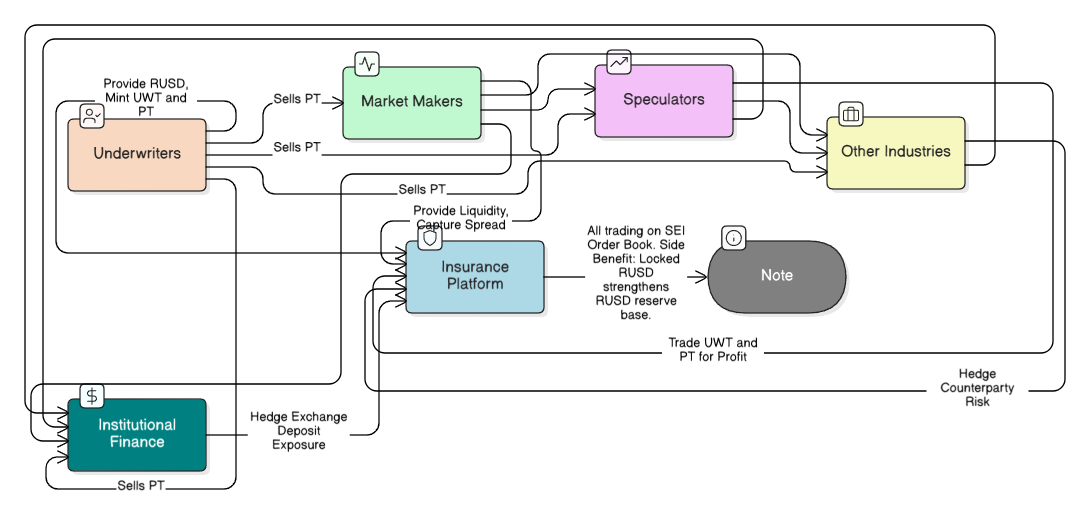
1. High-Level System Interaction
When an underwriter deposits 1,000 RUSD into an insurance pool, the contract mints a paired set of ERC-1155 tokens:
- Underwriting Token (UWT): Represents the underwriter’s claim on the pool’s RUSD reserve.
- Premium Token (PT): A wasting asset representing exposure to the insured event, transferable on secondary markets.
Redemption rules depend on whether the insured event occurs:
- If the event occurs: Oracles vote, and with board confirmation the pool is marked payable. PT holders may redeem 1 PT → 1,000 RUSD. UWTs expire worthless.
- If no event occurs (before expiry): Redemption requires burning both 1 UWT + 1 PT → 1,000 RUSD.
- If no event occurs (after expiry): On January 1st of the following year, PTs expire worthless and 1 UWT → 1,000 RUSD.
This dual-token system ensures that underwriting capital remains locked until outcomes are finalized, while PTs function as wasting assets whose value depends on the insured event. Both tokens trade freely on the Sei network’s native limit order book, paired against RUSD, where transparent price discovery occurs.
2. Universally Observable Events (UOEs)
Each insurance pool is tied to a Universally Observable Event (UOE), an outcome that is objective, public, and unambiguous. A UOE is the trigger condition that determines whether premium token holders are entitled to payout.
- Objective: Events are clearly defined, such as “Exchange X files for bankruptcy in Delaware in 2025.”
- Public: Any third party can verify the event without access to insider information.
- Static: Events occur at a fixed time and are not subject to ongoing interpretation.
This design ensures settlements are based on facts, not opinions, and prevents disputes or manipulation over whether an insured event has occurred.
3. Contract Design
The Insurance Contract is architected as a map of structs, where each struct represents an individual insurance pool:
- Pool Creation: Only the contract owner can create new pools by calling a function that specifies the pool name and associated UOE.
- Naming Convention: Each pool is identified by a code prefix. For example, a Coinbase pool for 2025 may be named CB2025, with its tokens automatically named CB2025UWT and CB2025PT.
- Annual Reset: New pools are typically created in December for the upcoming calendar year, or during the year if required, ensuring clear time-based boundaries.
This modular architecture allows multiple pools to coexist under one contract, each independently managed and transparently identifiable.
4. Risk Safeguards & Governance
The Insurance Contract integrates several institutional safeguards designed to prevent abuse and ensure investor confidence:
- Moral Hazard Cap: Issuance for each pool is limited to a maximum of 25% of the insured exchange’s assets under management (AUM), preventing over-insurance and eliminating perverse incentives.
- Oracle Governance: A vetted pool of oracles independently verifies UOEs and votes on outcomes. Consensus is required, and final confirmation is provided by the board before a pool can be marked payable.
- Permissive Action Links (Patent-Possible): Weak links (environmental conditions, such as stablecoin peg stability) and strong links (explicit human approvals, such as oracle voting) are combined to ensure that high-impact functions only execute when all conditions align.
- Compliance: AML/KYC is required for underwriters and withdrawals. All identity verification is handled by trusted third-party providers, ensuring regulatory readiness.
- Transparency: On-chain reporting tracks pool balances, issuance versus cap, oracle votes, and expirations, ensuring verifiable accountability.
- Zero Platform Fees: No fees are charged for minting, redemptions, or claims, ensuring efficient capital use.
- Reserve Stability Benefit: Locked RUSD in insurance pools reduces redemption pressure and increases deposits into the reserve, strengthening the monetary base and supporting long-term stability.
5. Participant Roles
The Insurance Contract ecosystem involves both direct and indirect participants. Direct participants interact with the contract itself, while indirect participants engage through the market for UWT and PT tokens.
- Underwriters (Direct): Provide RUSD liquidity, receive UWT/PT pairs, and retain a claim on reserves. They may trade tokens, manage exposure dynamically, and redeem depending on the UOE outcome:contentReference[oaicite:0]{index=0}.
- Premium Token Holders (Direct): Acquire PTs to gain event-contingent payout rights. They can trade freely in secondary markets, redeem upon oracle confirmation, and provide liquidity to the ecosystem:contentReference[oaicite:1]{index=1}.
- Oracles (Direct): Independent referees who verify UOEs, vote on event outcomes, and maintain readiness. They operate under strict neutrality and security guidelines, with board oversight:contentReference[oaicite:2]{index=2}.
- Board / Owner (Direct): Creates new pools, manages governance functions, confirms oracle consensus, and ensures compliance oversight.
- Market Makers (Indirect): Provide liquidity on the SEI order book by buying and selling UWT and PT. They capture bid/ask spreads while ensuring efficient price discovery for other participants.
- Speculators (Indirect): Trade UWT and PT tokens to profit from price movements. They are not necessarily seeking insurance coverage but contribute to liquidity and market efficiency.
- Other Industries (Indirect): May acquire PTs as hedges against indirect bankruptcy exposure (e.g., suppliers owed funds on net-90 terms, or counterparties dependent on the exchange). This extends the product’s use beyond deposit insurance into broader counterparty risk management.
6. Vision and Legal Positioning
The Insurance Contract is designed to evolve into a short-term, tradeable instrument that allows institutions to protect deposit exposure when engaging with untrusted exchanges. By structuring coverage around transparent UOEs and secondary market liquidity, the system offers institutions a flexible hedge against counterparty risk.
Institutions can acquire Premium Tokens (PTs) at the start of an engagement cycle — when they deposit funds onto an exchange to execute a trade. During the period that their assets are exposed (deposit, trading, settlement, withdrawal), the PT provides event-contingent protection against exchange bankruptcy. Once funds have been safely withdrawn, the institution may resell the PTs in the secondary market, effectively paying only for the exact period of risk exposure. This transforms insurance into a dynamic, on-demand risk management tool that aligns perfectly with the fast-moving nature of digital asset markets.
Important Disclaimer: Participation in an insurance pool does not constitute a legal claim against a bankruptcy estate. If an insured event occurs and the pool pays out, participants remain free to pursue claims through bankruptcy proceedings independently.