Technical Design
The On-Chain Architecture Behind DeepRUSD. DeepRUSD is built on a modular smart contract system that combines stablecoin reserves, insurance pools, credit facilities, escrow services, and on-chain compliance. Each subsystem is designed to be auditable, interoperable, and institution-ready.
1. ERC-20 Reserve Contract (Ethereum)
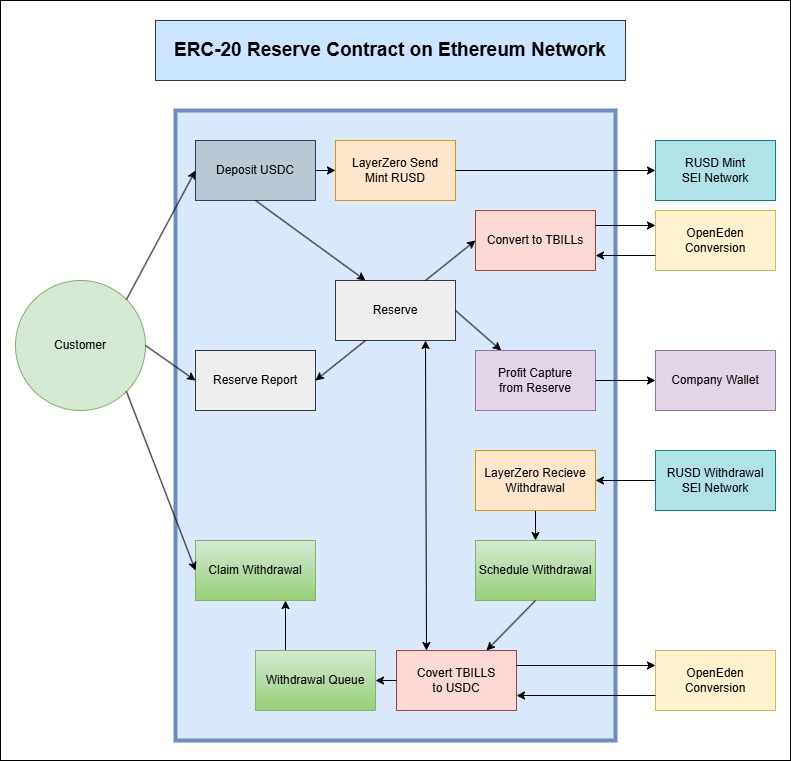
The reserve contract anchors RUSD’s value by holding USDC deposits and converting them into USDO tokens, which are yield-bearing instruments managed by OpenEden. This ensures stable backing of RUSD without requiring direct exposure to T-Bills at the contract level. All deposits and redemptions occur on Ethereum, while RUSD itself circulates on the Sei Network.
LayerZero messaging bridges Ethereum and Sei, enabling minting and redemption of RUSD. Withdrawals are queued, converted, and distributed in a fully on-chain workflow.
2. ERC-1155 AML/KYC Compliance Cache
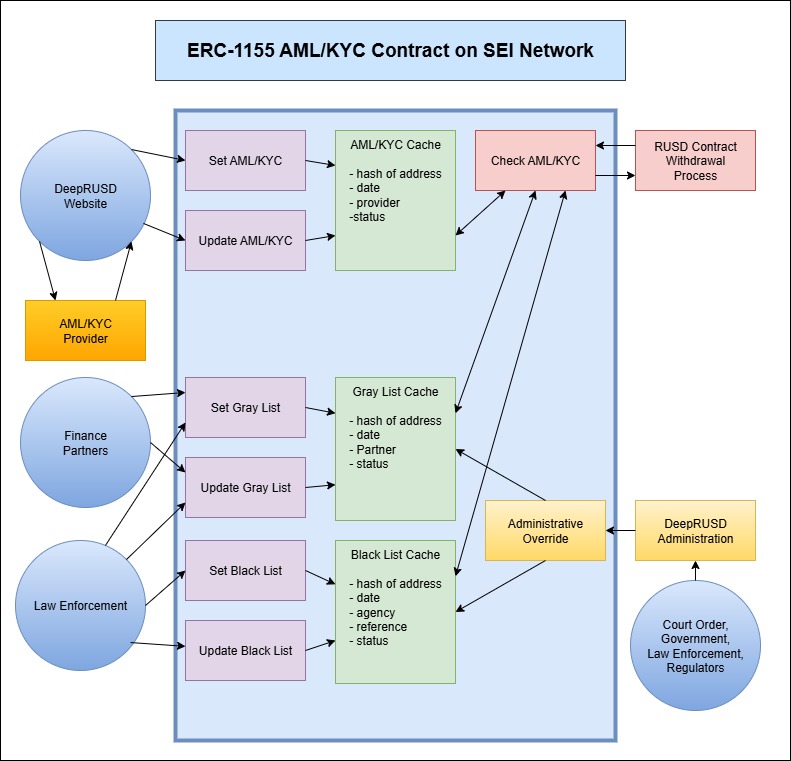
The compliance cache ensures regulatory integrity by storing hashed addresses and their AML/KYC attributes (date, servicer, sanction result, type, validation level). It supports greylist and blacklist enforcement, enabling institutions and regulators to freeze or restrict accounts in line with legal processes. This cache integrates with all DeepRUSD products to enforce compliance at the protocol level.
3. ERC-1155 RUSD Contract
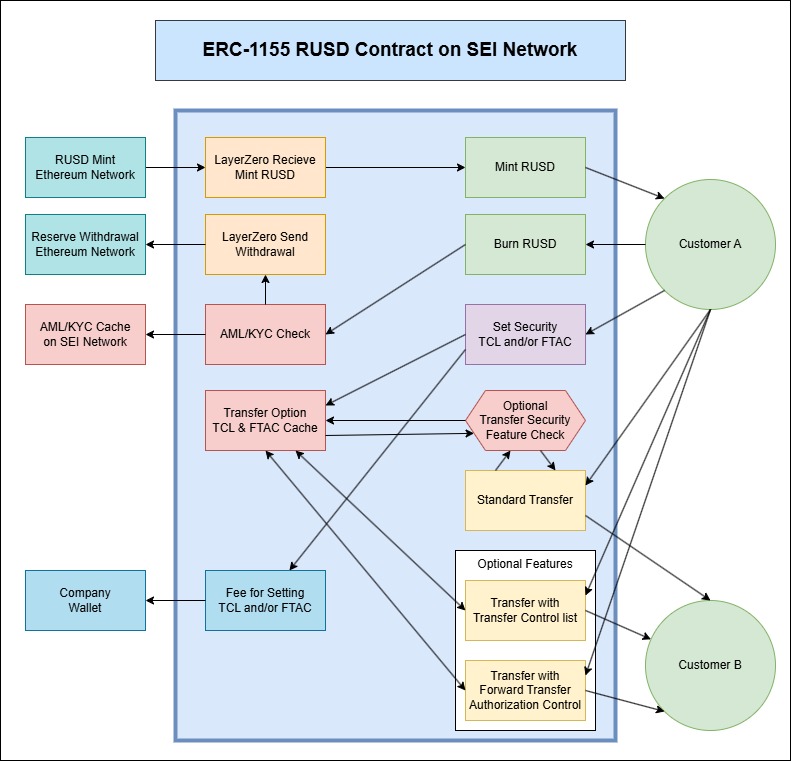
RUSD on the Sei Network introduces advanced transfer security features:
- Standard Transfers for everyday use.
- Transfer Control Lists (TCL) to restrict transfers to approved counterparties.
- Forward Transfer Authorization Control (FTAC) to pre-approve downstream transfers.
These features, combined with AML/KYC enforcement, enable RUSD to meet institutional-grade compliance and security requirements while retaining open utility in secondary markets.
4. ERC-1155 Insurance Contract
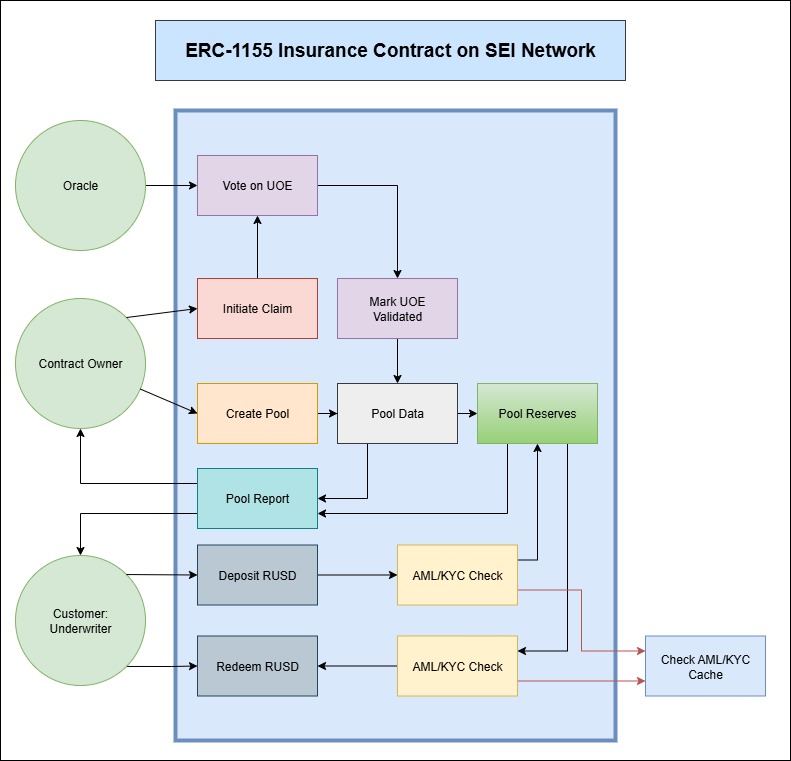
The insurance contract enables the issuance, management, and settlement of insurance pools. Underwriters deposit RUSD into a pool tied to a Universally Observable Event (e.g., “Exchange X bankruptcy in 2025”). For every 1000 RUSD deposited, they are minted 1 Underwriting Token (UWT) and 1 Premium Token (PT).
- If the event does not occur, UWT can be redeemed for the original RUSD after expiry, while PT expires worthless.
- If the event does occur, PT becomes redeemable for RUSD from the pool, while UWT cannot be redeemed.
Issuance is capped at 25% of the insured institution’s assets under management to prevent moral hazard. Disputes are settled through human oracle voting, with pools marked payable if consensus validates the event. Premium tokens are freely tradable on Sei’s native order book, allowing price discovery and liquidity.
5. Credit Facility Contract
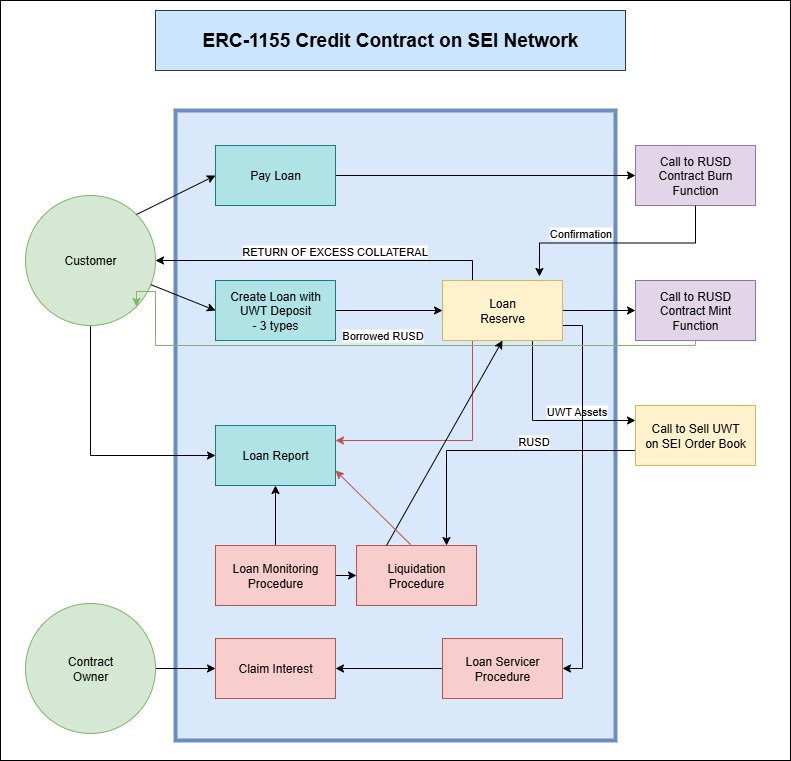
The credit facility enables underwriters to post unexpired UWT as collateral and receive RUSD loans. At least three equal units of UWT are required to open a loan, with borrowing capped at 20% LTV. Monthly interest (1.5%) is paid via deductions from collateral. If collateral value drops below 70% of its initial value, automatic liquidation occurs, repaying the loan and returning any balance (minus fees) to the borrower.
Collateral can be swapped between UWT or RUSD during the loan, and additional RUSD may be added to improve LTV and prevent liquidation. This facility supports underwriters seeking additional liquidity, operational funding, or tax-deferral strategies.
6. Escrow Contract
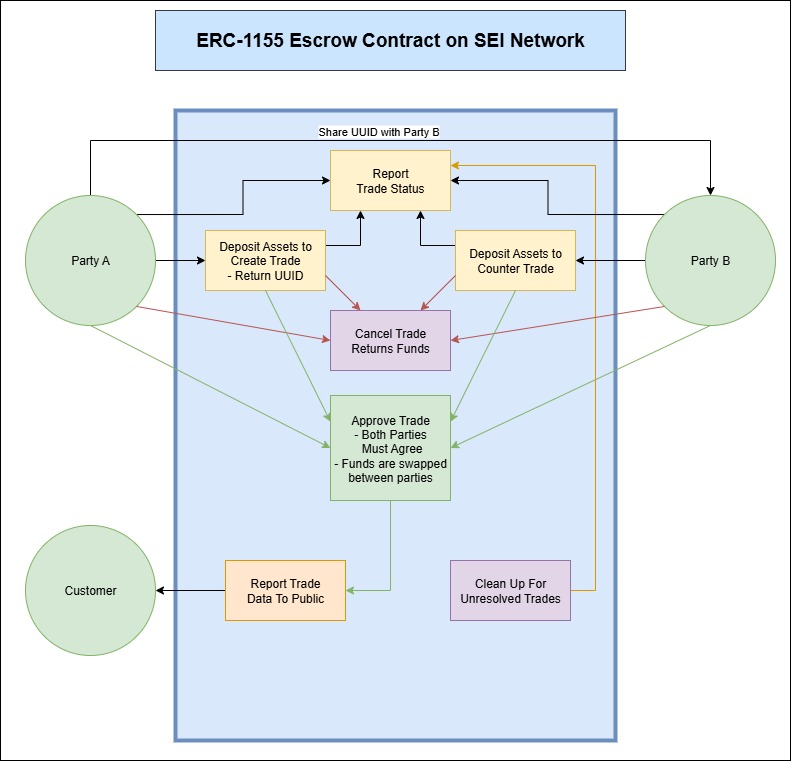
The escrow service allows two parties to exchange assets in a trustless environment. Assets are deposited into UUID-based settlement vaults. Both parties must agree on the contents of two “buckets” (their respective asset deposits) for resolution to occur. If one party changes terms, the other party’s agreement resets until consensus is reached.
The contract supports ERC-20, ERC-721, and ERC-1155 tokens. While the escrow will be primarily deployed on the Sei Network for high-throughput, low-cost settlement, a deployment on Ethereum is also planned, enabling wider interoperability for institutional counterparties.
If unresolved after 1 month, the escrow is cancelled and funds are returned. After 1 year, unreclaimed funds are marked as abandoned property and may be claimed by the contract owner in accordance with jurisdictional law. Optional AML/KYC enforcement ensures that only verified counterparties can engage in agreements.
7. Security & Governance
Across all contracts, security is reinforced by Permissive Action Links, AML/KYC enforcement, and role-based governance. Governance functions include adding insurance pools, approving compliance providers, managing abandoned escrow, and integrating arbitration mechanisms where appropriate.
8. Ecosystem Integration
Each subsystem is modular but interoperable:
- Stablecoin Reserve: Provides the foundation of value and liquidity, backed by USDO tokens.
- Compliance Cache: Acts as the backbone for AML/KYC enforcement across all flows.
- RUSD Contract: Enables secure, compliant usage of RUSD on-chain.
- Insurance Pools, Credit Facility, Escrow: Build on these primitives to create institutional-grade financial instruments.
Together, this design delivers a transparent, compliant, and capital-efficient architecture for the institutional adoption of tokenized finance.
9. Off-Chain Infrastructure
In addition to the on-chain smart contract architecture, DeepRUSD maintains a dedicated website and server infrastructure that supports compliance, reporting, data collection, and institutional integration.
- Transaction Data Collection: Secure servers collect on-chain transaction data for internal reporting and for triggering regulatory filings (e.g., suspicious activity or large transactions) in accordance with jurisdictional requirements.
- Web Application: Customers log in with Metamask wallets to access a suite of tools:
- Trading interface with charts for UWT and PT markets (via Sei’s limit order book).
- Liquidity provision interface.
- Public-facing contract function tools.
- Reserve and pool data reporting for transparency.
- Dedicated AML/KYC Check Page where customers complete AML/KYC and sanction checks with supported third-party providers. Results are written into the AML/KYC cache via Trust Wallet integration.
- Institutional API: A cloud-based enterprise service bus (e.g., RabbitMQ) provides secure, real-time access to contract reporting without requiring institutions to query contracts directly. RPC services over this bus make onboarding seamless while reducing costs for partners.
- Operational Monitoring: Continuous oversight of contract interactions, reserve balances, and transaction flows to maintain system integrity.
This off-chain infrastructure complements the decentralized protocol by enabling regulatory engagement, institutional integration, and operational resilience.